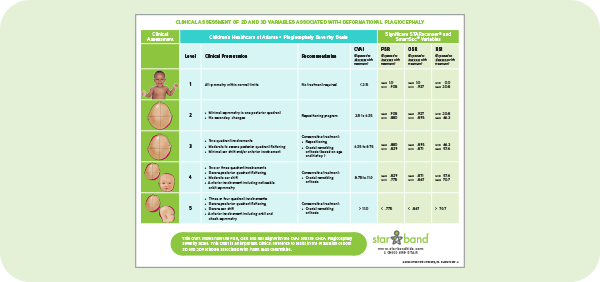
The 2006 Children’s Healthcare of Atlanta (CHOA) publication was among the first to describe the clinical reliability and value of STARscanner® measurements. Five cranial measurements were identified as significant clinical variables in the classification of head shape severity:
- Asymmetry
- Posterior Symmetry Ratio (PSR)
- Overall Symmetry Ratio (OSR)
- Cranial Vault Asymmetry Index (CVAI)
- Radial Symmetry Index (RSI)
- Disproportion
- Cephalic Index (CI) (*CI is only useful for brachycephalic head shapes)
“The ratios or indices found to be the best predictors in plagiocephaly (i.e., CVAI, RSI, PSR, and OSR) are useful to clinicians because they provide an accurate, reproducible comparison of one subject to another regardless of age or head circumference” when using the anatomical landmarks for the CCU reference plane."
Plank LH, Giavedoni B et al. Comparison of infant head shape changes in deformational plagiocephaly following treatment with a cranial remolding orthosis using a noninvasive laser shape digitizer. J Craniofac Surg 2006 Nov; 17(6): 1084-91.
In 2017, the CHOA Plagiocephaly Severity Scale originally established by Plank in 2006 was additionally validated and supported.
“The CHOA severity scale provides an efficient and reproducible method for the clinical team to evaluate plagiocephaly in an infant both observationally and quantitatively and to provide a treatment plan in a less biased manner that is based on outcomes.”
Holowka MA, Reisner A et al. Plagiocephaly Severity Scale to Aid in Clinical Treatment Recommendations. J Craniofac Surg. 2017 May;28(3):717-722.